Underground vs Above-Ground Natural Gas Line Installation: Which Is Safer
When a Vancouver WA or Battle Ground homeowner adds a gas appliance, extends service to a detached garage, or installs an outdoor kitchen or fire feature, one of the first questions Service Source Plumbing gets asked is whether the gas line needs to go underground or whether it can run above ground. The answer is not simply a matter of preference.
Both installation methods are used on Clark County properties. Both are governed by specific Washington State code requirements. And both have situations where one is clearly the right choice and the other is not an option. Understanding which applies to a specific installation, and why, is what determines whether the project is done safely, legally, and in a way that does not create problems for the homeowner down the road.
This guide explains how underground and above-ground gas line installations differ, what Washington State and the International Fuel Gas Code require for each, and how Service Source Plumbing determines which approach is appropriate for a specific project in Vancouver, Battle Ground, Yacolt, Hockinson, or Woodland.
The new season is a great reason to make and keep resolutions. Whether it’s eating right or cleaning out the garage, here are some tips for making and keeping resolutions.
Lists are great ways to stay on track. Write down some big things you want to accomplish and some smaller things, too.
Check the list regularly
Don’t forget to check in and see how you’re doing. Just because you don’t achieve the big goals right away doesn’t mean you’re not making progress.
Reward yourself
When you succeed in achieving a goal, be it a big one or a small one, make sure to pat yourself on the back.
Think positively
Positive thinking is a major factor in success. So instead of mulling over things that didn’t go quite right, remind yourself of things that did.

How Each Installation Method Works
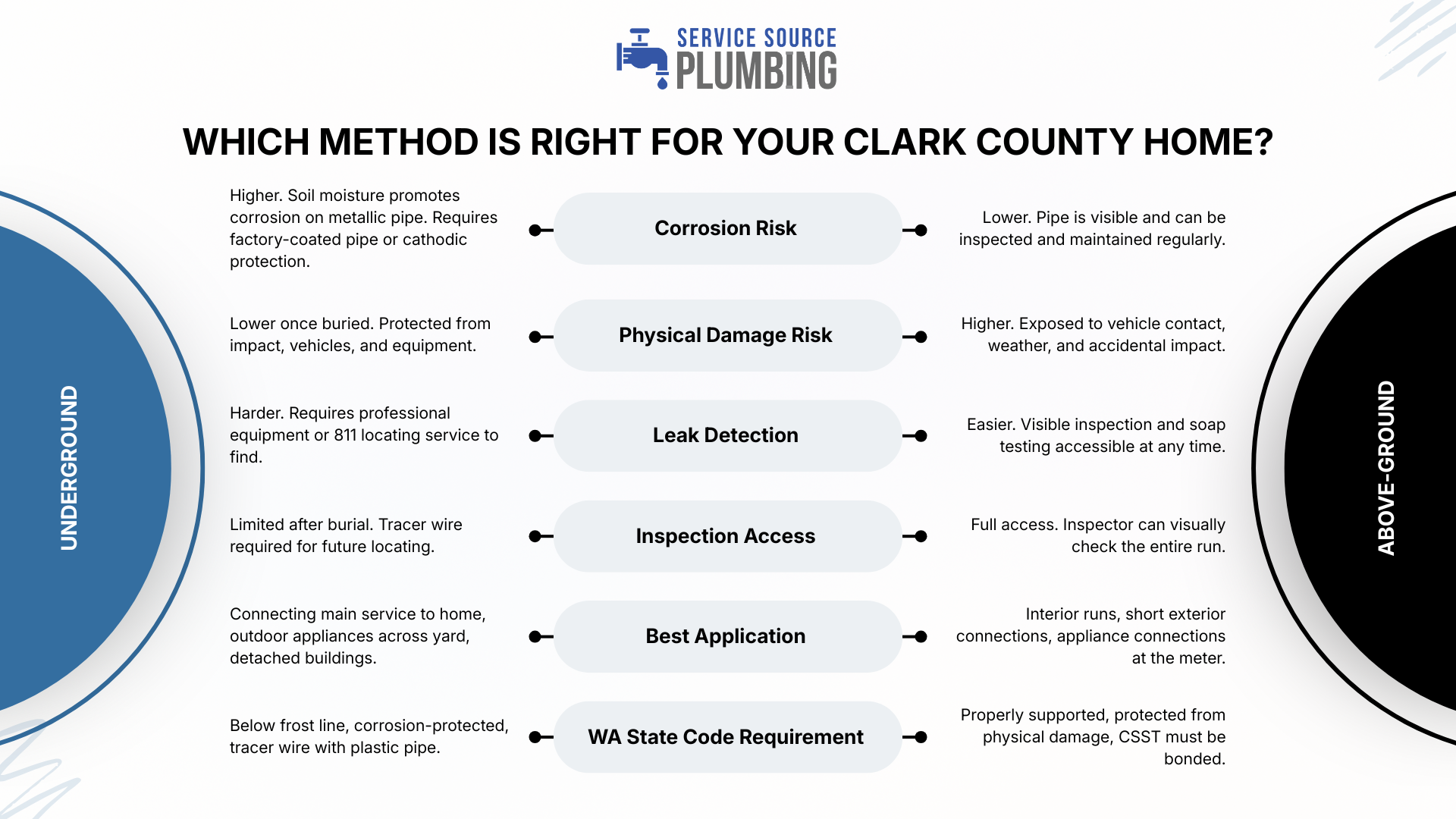
| Factor | Underground Gas Line | Above-Ground Gas Line |
|---|---|---|
| Primary application | Connecting main service to structure, outdoor appliances across yard, detached buildings | Interior runs, short exterior connections, exposed appliance connections at the meter |
| Code requirement | Must be below frost line, corrosion-protected, and include tracer wire per Washington State IFGC | Must be protected against physical damage and properly supported |
| Material options | Polyethylene (PE) plastic, coated steel, or CSST in conduit | Black iron pipe, CSST, corrugated stainless steel tubing |
| Corrosion exposure | Higher: soil moisture promotes galvanic corrosion on metallic pipe | Lower: above-ground pipe can be inspected and maintained visually |
| Physical damage risk | Lower once buried: protected from impact | Higher: exposed to vehicle contact, weather, and physical damage |
| Leak detection | Harder: requires professional equipment or 811 locating | Easier: visible inspection and soap testing accessible |
| Permit required | Yes | Yes |
Washington State Code Requirements for Underground Gas Lines
Washington State adopts the International Fuel Gas Code (IFGC) as amended, which governs all gas piping installation throughout Clark County. According to Washington Administrative Code 296-24-68207, underground gas pipe must be located below the frost line and protected against corrosion.
The specific requirements Service Source Plumbing follows for underground gas line installation in Clark County:
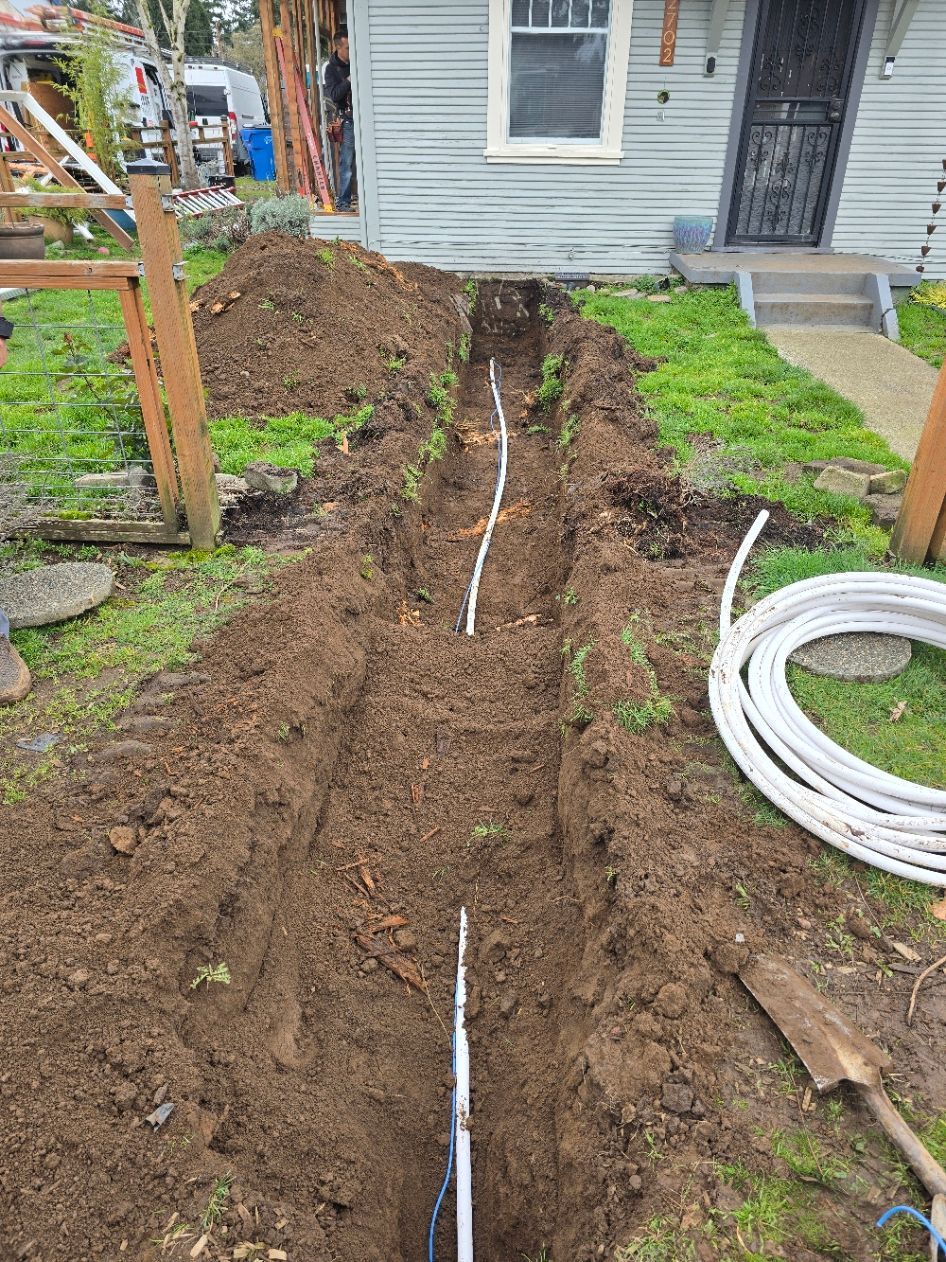
- Burial depth: Underground gas lines must be installed below the frost depth for the installation area. In Clark County, this is generally a minimum of 12 to 18 inches for service lines, with deeper burial required in some conditions and for certain pipe materials
- Corrosion protection: According to the International Code Council's underground gas piping requirements, metallic piping installed underground is more prone to corrosion than above-ground piping. The IRC and IFGC require underground piping to use corrosion-resistant material, factory-applied electrically insulating coating, or cathodic protection systems
- Tracer wire: Per Washington State gas piping requirements, polyethylene or PB plastic piping requires an 18 AWG yellow insulated copper tracer wire installed with the pipe to allow future locating without excavation
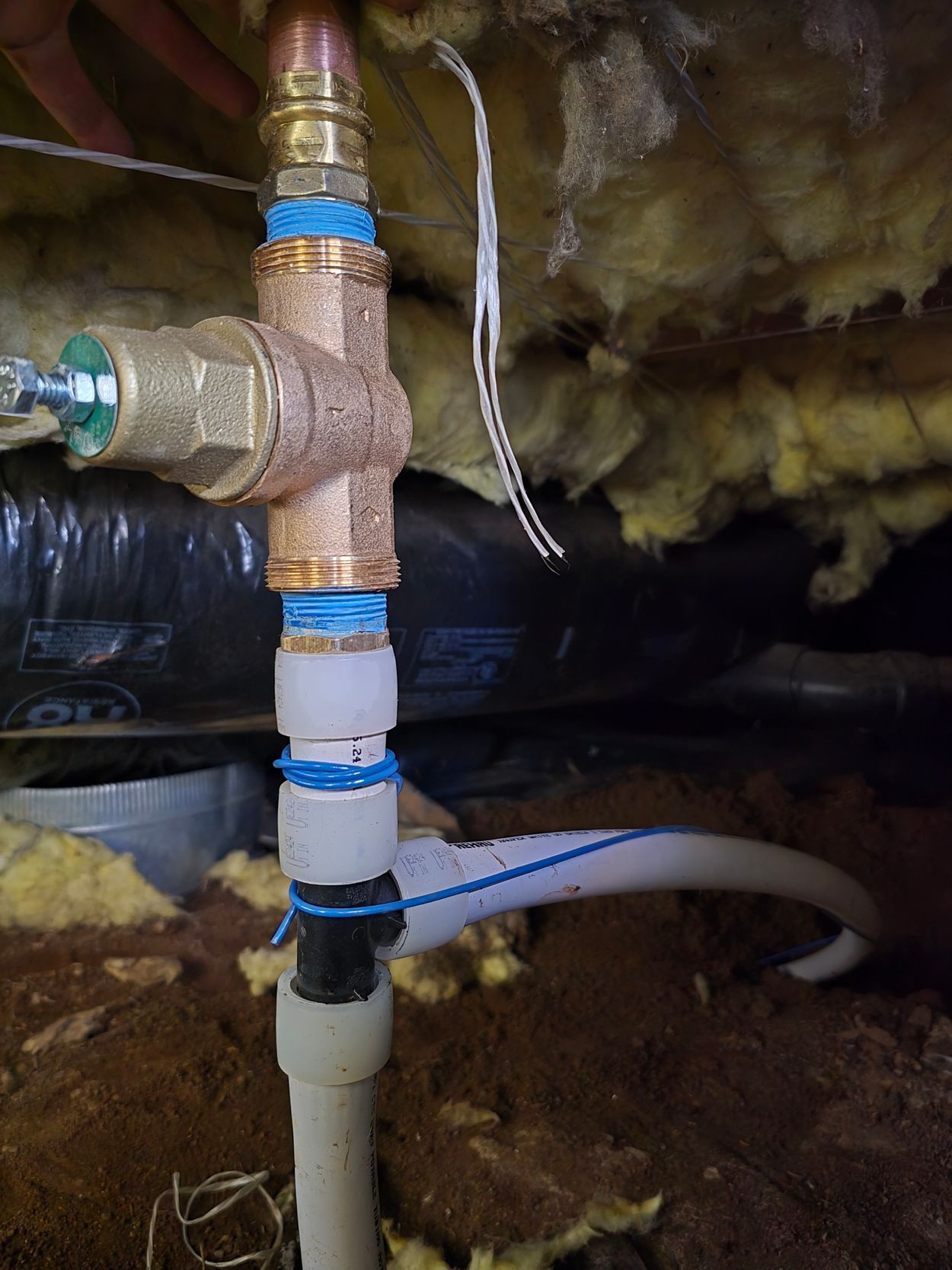
- Plastic pipe limitations: Per the IFGC, plastic pipe cannot be used within or under any building slab and cannot operate at pressures greater than 100 psi for natural gas. Plastic pipe can only transition above ground through approved anodeless risers or service head adapters installed per manufacturer instructions
- Inspection before backfill: Underground piping must be inspected and approved before being covered. Work cannot proceed to backfill until the licensed inspector has signed off on the installation
The 811 requirement before any excavation:
Any excavation in Clark County that may contact underground utilities, including gas lines already in the ground, requires a call to 811 before digging begins. This is a legal requirement under Washington State law, not a recommendation. Service Source Plumbing calls 811 on every project that involves any ground disturbance, and homeowners who attempt DIY gas line work or hire unlicensed contractors who skip this step risk damaging existing underground gas infrastructure.
Washington State Code Requirements for Above-Ground Gas Lines
Above-ground gas lines are subject to their own set of requirements that determine where they can be used, how they must be supported, and what protections are required against physical damage and weather exposure.
Key requirements for above-ground gas line installation in Clark County:
- Physical damage protection: All above-ground gas piping must be protected against physical damage where it is exposed to vehicle traffic, equipment contact, or other impact risk
- Support spacing: Above-ground gas pipe must be properly supported at regular intervals appropriate to the pipe material and diameter to prevent sagging and stress at connections
- Weatherproofing: Exterior above-ground pipe must be protected against weather exposure. Ferrous pipe and tubing must be coated or painted with a suitable corrosion-resistant material
- CSST bonding: Corrugated stainless steel tubing used as above-ground gas piping must be bonded to the electrical service grounding electrode system with a bonding jumper no smaller than 6 AWG copper wire, per Washington State CSST requirements
- Building penetrations: Gas piping cannot penetrate the building foundation wall below grade. Where pipe transitions from underground to above-ground to enter the building, the annular space around the pipe at the wall penetration must be sealed
Which Method Is Used for Which Applications in Clark County
Service Source Plumbing determines the appropriate installation method based on the specific application, the route the gas line must take, and the code requirements that apply to each situation. Neither method is universally superior for every project.
| Application | Typical method | Why |
|---|---|---|
| Connecting main utility service to home meter | Underground | Required by utility company standards for service entrance |
| Running gas to a detached garage across the yard | Underground | Distance requires burial to protect from damage and weather |
| Outdoor kitchen or fire pit across the property | Underground | Protects line from landscaping activity and foot traffic |
| Gas stub-out at the meter for appliance connection | Above-ground | Short run, accessible for inspection and service |
| Interior gas line to range, dryer, or furnace | Above-ground | Interior runs follow above-ground requirements |
| Gas line under a concrete patio or driveway | Underground in conduit | Plastic pipe under slabs requires approved conduit or sleeve |
| Generator connection in a fixed outdoor location | Above-ground or short underground run | Depends on generator placement and access requirements |
The Safety Comparison: What Each Method Protects Against and What It Does Not
The question of which installation is safer does not have a single answer because each method addresses different risks while introducing different considerations.
Underground installations protect against:
- Physical impact from vehicles, equipment, and accidental contact
- Weather exposure including freeze-thaw cycling effects on above-ground connections
- Tampering or accidental disconnection of exterior exposed pipe
Underground installations introduce:
- Corrosion risk from soil moisture, which is why corrosion protection is a code requirement, not optional
- Difficulty locating the line after burial without tracer wire or utility locating
- Excavation risk from future digging if the line location is not documented and marked
Above-ground installations protect against:
- Corrosion from soil contact
- Difficulty with visual inspection and leak detection
Above-ground installations introduce:
- Physical damage exposure from vehicles, equipment, and accidental impact
- Weather exposure requiring appropriate coating and maintenance
- Visibility that can create aesthetic concerns on finished properties
According to
Washington Gas's pipeline safety guidance, each customer is responsible for maintaining and monitoring all above-ground and underground piping on their side of the meter. If this piping is not properly maintained, it may corrode or leak. Gas piping on the customer's side should be periodically inspected for leaks and corrosion and repaired by a licensed natural gas contractor if unsafe conditions are detected.
Why Clark County Gas Line Work Requires a Licensed Plumber
Gas line installation is not a DIY project in Washington State, and it is not a project that should be hired to an unlicensed contractor regardless of how simple a specific run appears.
Washington State requires that all gas line work be performed by a licensed plumber or gas fitter who has passed the required examinations and carries the appropriate license from the Department of Labor and Industries. Work performed by unlicensed contractors does not meet Washington State building code standards, cannot be inspected and approved, and creates liability for the homeowner if a leak or failure occurs.
Service Source Plumbing is fully licensed for gas line installation throughout Vancouver, Battle Ground, Yacolt, Hockinson, and Clark County. Every gas line project includes:
- Pull of the required permit before work begins
- 811 call for any project involving excavation
- Pressure testing of the completed installation as required by code
- Inspection coordination with the appropriate authority having jurisdiction
- Written documentation of the installation for the homeowner's records
Should You Call Before Your Gas Line Project?
| Situation | What to do |
|---|---|
| Adding gas to a detached garage or outbuilding | Call Service Source Plumbing for assessment and permit |
| Installing an outdoor kitchen, fire pit, or generator | Call before purchasing any equipment. Line routing affects the project |
| Extending an existing gas line to a new appliance | Permit required regardless of line length |
| Smelling gas anywhere on the property | Leave immediately, call 911, then call the gas utility |
| Planning any excavation near where gas lines may run | Call 811 before digging, then call Service Source Plumbing |
| Unsure whether your existing gas line is properly installed | Schedule an inspection. Seller disclosures do not always reflect actual installation condition |
Frequently Asked Questions
Does gas line installation in Vancouver WA require a permit?
Yes. All gas line installation in Clark County requires a permit from the appropriate authority having jurisdiction, whether that is the City of Vancouver, Battle Ground, or Clark County for unincorporated areas. Service Source Plumbing pulls permits for every gas line project. Unpermitted gas work creates liability for homeowners and may complicate property sales.
Can I run a gas line to my detached garage myself?
No. Washington State requires gas line work to be performed by a licensed plumber or gas fitter. Beyond the legal requirement, gas line installation involves pressure testing, code compliance, and 811 utility locating that require professional equipment and licensing to perform correctly.
How deep does underground gas line need to be in Clark County?
The minimum burial depth follows the International Fuel Gas Code as adopted by Washington State, generally 12 to 18 inches for residential service lines, with deeper burial required in some situations. Service Source Plumbing follows current code requirements for each specific installation.
What is the difference between black iron pipe and CSST for gas lines?
Black iron pipe is the traditional material for gas line installation, rigid and durable. CSST (corrugated stainless steel tubing) is a flexible alternative that allows routing around obstacles more easily. Both are code-compliant when properly installed. CSST requires bonding to the electrical grounding system per Washington State requirements. Service Source Plumbing uses both materials based on the specific project requirements.
What should I do if I smell gas outside near a gas line?
Leave the area immediately. Do not use any electrical switches, phones, or anything that could create a spark. From a safe distance, call 911 and your gas utility's emergency line. Do not return to the area until emergency responders confirm it is safe. Gas leaks on the customer's side of the meter are the homeowner's responsibility and require a licensed plumber to repair.
How long does a gas line installation take?
Most residential gas line installations are completed in one to two days including excavation, pipe installation, pressure testing, and inspection scheduling. More complex projects involving longer runs or multiple appliance connections may require additional time.
If you're planning a gas line installation or extension in Vancouver, Battle Ground, Yacolt, or the surrounding Clark County communities, Service Source Plumbing can assess the project, explain your options, and handle the installation from permit to final inspection.
Read: 6 Plumbing Problems That Always Get Worse When You Wait
why choose
service source plumbing?
Get in Touch Today
Homeowners and businesses in Battle Ground, Duluth, Hockinson, Vancouver, Orchards, and Walnut Grove rely on us for our:
- 24/7 emergency services – We’re always ready to assist with urgent plumbing issues.
- Experienced professionals – Our team is trained in advanced drain cleaning techniques.
- State-of-the-art equipment – We use the latest tools to ensure safe and effective unclogging.
- Commitment to customer satisfaction – We deliver reliable, long-term plumbing solutions.
- Preventative inspections – We don’t just fix the issue; we help you prevent future problems.